
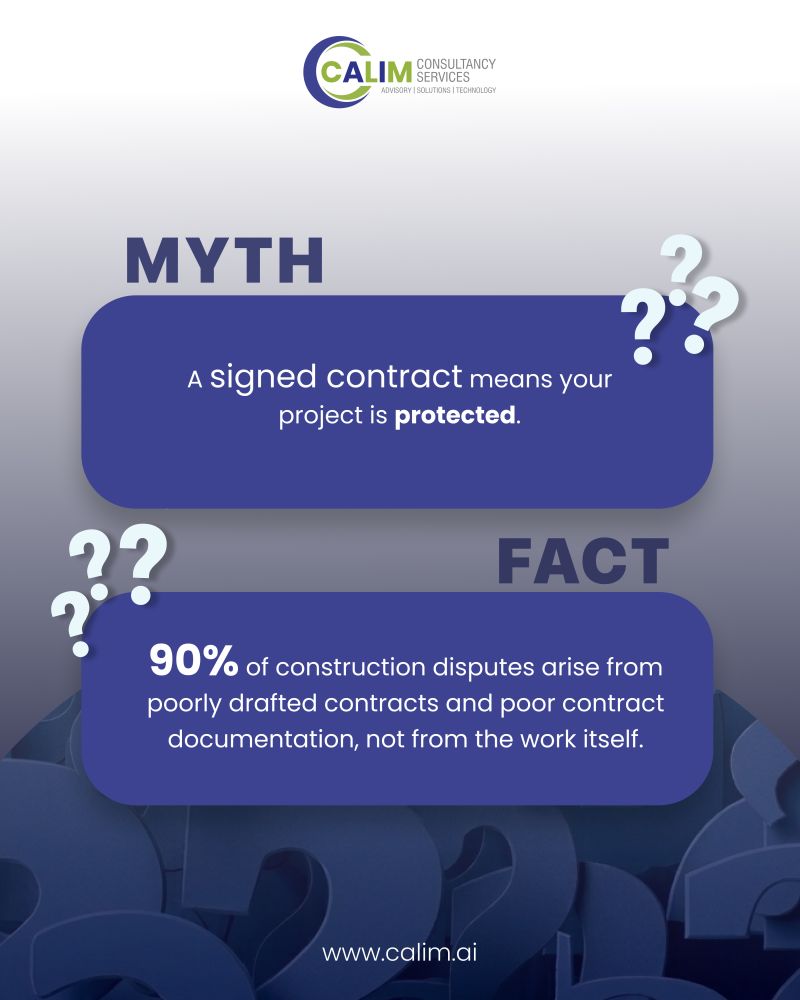
We review hundreds of Extension of Time claims across the GCC every year. The delays are real. The costs are legitimate. The impact is measurable. But the claim still gets rejected.
The reasons are almost always the same: late notification, weak cause-and-effect linkage, insufficient contemporaneous records, wrong methodology, and poor documentation quality.
Late notification is the most common killer. Under FIDIC, the contractor must notify the Engineer within 28 days of becoming aware of the delay event. Miss this window and the claim is time-barred, regardless of merit.
Weak cause-and-effect linkage is the second. It is not enough to show that a delay occurred and that the project finished late. The claim must demonstrate a clear, logical, and documented link between the specific delay event and the impact on the critical path.
Insufficient contemporaneous records come next. Claims built retrospectively — from memory, from reconstructed timelines, from incomplete diaries — carry fundamentally less weight than claims supported by records created at the time the events occurred.
Wrong methodology matters more than most contractors realise. An EOT claim analysed using a method that does not suit the contract, the programme, or the nature of the delay will be challenged — and often rejected — on methodology alone, before the substance is even considered.
Finally, documentation quality. A claim that is poorly structured, difficult to follow, or inconsistent in its narrative gives the Engineer every reason to push back. Presentation is not a substitute for substance, but substance without clear presentation is almost as ineffective.
At CALIM, we build EOT claims that address all five of these failure points from the outset. The result is claims that are harder to reject — because the work was done properly the first time.
Tins Varghese
Chief Commercial & Strategy Officer
Need help with eot claims?
Talk to a specialist